
Your First Test
Take a flow that calls an API you cannot reach, and get a green test suite for it in about ten minutes.
A flow that calls a payment API cannot run where there is no payment API. The trick is to stand in for the block that calls out and let the rest of the flow run for real. This page walks that end to end on a flow that ships with octo. Every command and every line of output on this page was run to produce it.
Set up
You need both binaries. From a clone of the repository:
task build                          # writes bin/octo and bin/dolphin
export OCTO_PATH=$PWD/bin/octo      # the octo dolphin will drive
export PATH=$PWD/bin:$PATH          # so `dolphin` is on your path
dolphin runs your tests by running the real octo, so it needs to find a binary.
See installation for the release
tarballs if you would rather not build.
Make a scratch directory with one flow in it:
mkdir ~/octo-first-test && cd ~/octo-first-test
cp /path/to/octo/samples/error-handling.yaml .
The flow under test is charge-inline. It POSTs a charge to an upstream inside a
handle-errors block, so a failure becomes a "degraded" body rather than a 500. Its
upstream is http://127.0.0.1:9, the discard port: every call fails to connect, so
"it failed" is the only outcome the real flow can produce.
Get to green before you assert anything
Write this as error-handling_test.yaml, beside the flow:
flow: charge-inline

cases:
  - name: it runs to the end
    expect: {}
Run it:
dolphin test error-handling.yamlok error-handling_test.yaml (charge-inline) 68ms
1 passed, 0 failed, 0 errored, 0 skipped (68ms)dolphin found the suite by itself: you pointed at the flow file and it ran the
_test.yaml beside it, as Go pairs orders.go with orders_test.go. octo skips
_test.yaml when it loads a directory.
An empty expect is not an empty test. It asserts that the flow ran to the end
and did not fail, which passes here because the handle-errors chain recovers.
Stand in for the block that calls the world
Replace the file with:
flow: charge-inline

mocks:
  charge-inline.charge[process].call-charge:
    default:
      body: { id: ch_1, status: captured }

cases:
  - name: a charge the bank accepts comes back captured
    input:
      data: { amount: 10 }
    expect:
      body: { id: ch_1, status: captured }
dolphin test error-handling.yamlok error-handling_test.yaml (charge-inline) 94ms
1 passed, 0 failed, 0 errored, 0 skipped (94ms)The mock replaces the call-charge block: the HTTP request never happens and the
flow gets { id: ch_1, status: captured } as if the bank had said so. Everything
around it ran for real.
The address charge-inline.charge[process].call-charge reads left to right: the flow,
the handle-errors block named charge, its process slot, and the block inside it.
See the address grammar. In the editor a picker
lists the addressable blocks.
input.data is the body the flow is called with. It matters even though the mock
ignores it, because sources do not run under a test: nothing populates the message
unless the case does. A flow reading request headers needs input.vars too.
Break it on purpose
Change the expected id from ch_1 to ch_2, leave the mock alone, and run it again:
FAIL error-handling_test.yaml  (charge-inline)  77ms
  --- FAIL: a charge the bank accepts comes back captured (77ms)
        expect.body:
              want: {"id":"ch_2","status":"captured"}
              got:  {"id":"ch_1","status":"captured"}
        reproduce: /path/to/bin/octo invoke --config error-handling.yaml \
          --flow charge-inline \
          --run-debug-config /tmp/dolphin-143073336/error-handling_test.0.yaml \
          --timeout 30s \
          --envelope-out /tmp/dolphin-143073336/error-handling_test.0.outcome.json

0 passed, 1 failed, 0 errored, 0 skipped  (77ms)

the runs are in /tmp/dolphin-143073336
The failure has three parts: the case name in the words you wrote, want against
got, and reproduce, a runnable octo command that re-runs exactly this case. The
debug config for a failing case is kept on disk so that command works.
Put ch_1 back and confirm it is green again before moving on.
A block's value: setting is a CEL expression, so value: "502" in a flow
evaluates to the number 502 (the quotes are YAML's, not CEL's). When a mismatch is
only a type, dolphin says so: want "502", got 502 (a string, not a number).
Test the path you wrote the flow for
charge-inline exists to survive a failing charge. Add a second case that overrides
the mock for itself, so the block fails:
flow: charge-inline

mocks:
  charge-inline.charge[process].call-charge:
    default:
      body: { id: ch_1, status: captured }

cases:
  - name: a charge the bank accepts comes back captured
    input:
      data: { amount: 10 }
    expect:
      body: { id: ch_1, status: captured }

  - name: a declined card is recovered into a degraded body
    input:
      data: { amount: 500 }
    mocks:                              # replaces the file's mock, for this case only
      charge-inline.charge[process].call-charge:
        default:
          error: card declined
    expect:
      that:
        - 'body.status == "degraded"'
        - 'body.reason.contains("card declined")'
    spies:                              # and prove the block was actually reached
      charge-inline.charge[process].call-charge:
        count: 1
        records:
          - error: card declined
ok error-handling_test.yaml (charge-inline) 119ms
2 passed, 0 failed, 0 errored, 0 skipped (119ms)Three new ideas. error: on a mock fails the block exactly as a real failure would.
that: holds CEL expressions over the result, each of which must be
true; use it instead of an exact body when you do not want to pin a message word for
word. spies: assert on what happened inside the flow: count: 1 says the block was
reached exactly once, and the record says it failed. Without the spy, a flow that
skipped the charge and returned a degraded body for another reason would still pass.
Run it the way CI will
Point dolphin at the directory and it runs every suite in it:
dolphin test .ok error-handling_test.yaml (charge-inline) 149ms
2 passed, 0 failed, 0 errored, 0 skipped (149ms)The exit code is the contract a pipeline acts on:
| Code | Meaning |
|---|---|
| 0 | Every case passed. |
| 1 | A case ran and did not do what it said. The flows are wrong. |
| 2 | A case never ran: a bad address, a config that will not parse. The suite is wrong. |
Add --junit report.xml and your CI system will render the cases by name; see
running tests.
The same file, in the editor
Start the editor over the directory you just worked in:
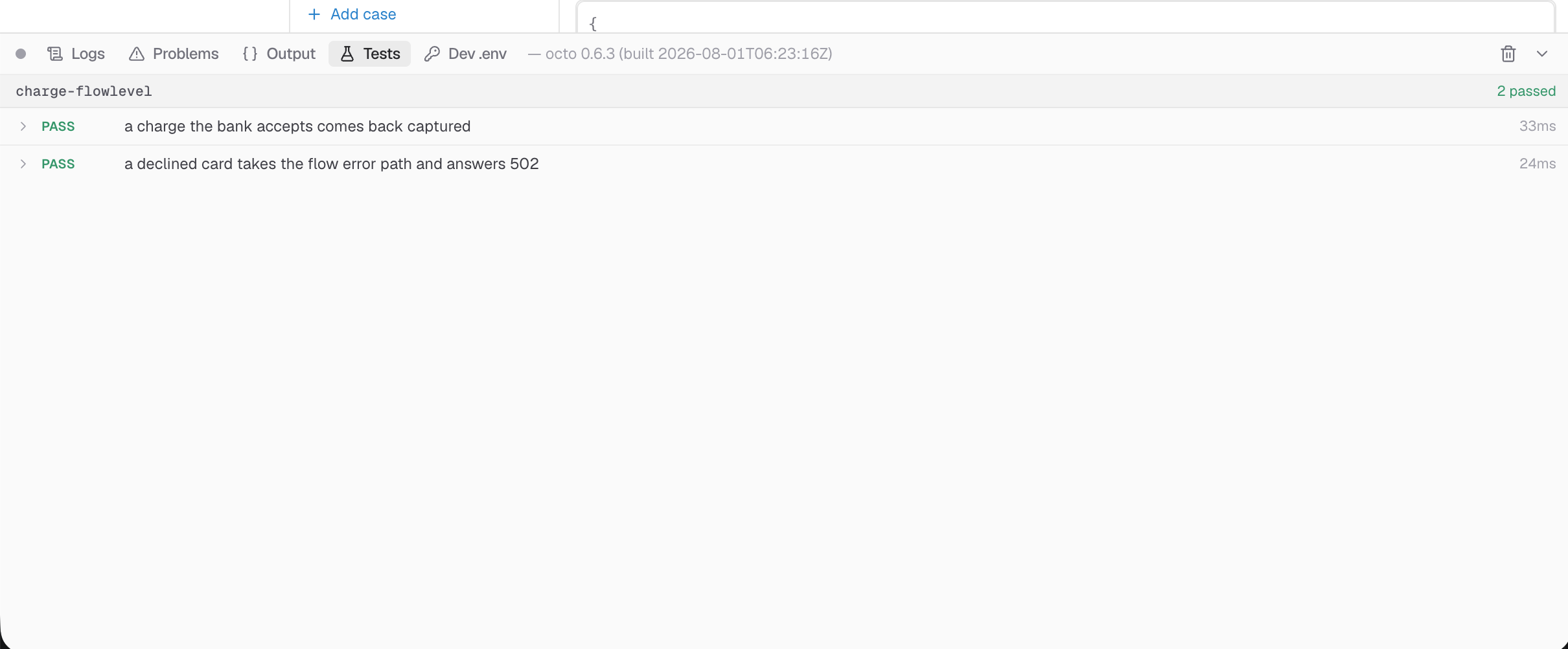
docker run -p 3000:3000 -v "$PWD:/work" juancavallotti/octoThe image ships dolphin and points the editor at it. The Testing tab opens the
suite you just wrote as a form, and Run tests gives the same verdict because it
shells out to the same binary.
What to read next
Writing test cases
The format in full: shared inputs, spies over a foreach, what expect can assert,
and the environment a suite needs.
Testing in the editor
The Testing tab, and the two bridges between it and the canvas.
Running tests
Flags, exit codes, JUnit and JSON reports, and a GitHub Actions job.
Test file reference
Every key of a _test.yaml, field by field.