
Build a REST API
Serve HTTP endpoints with routing, path params, and response shaping.
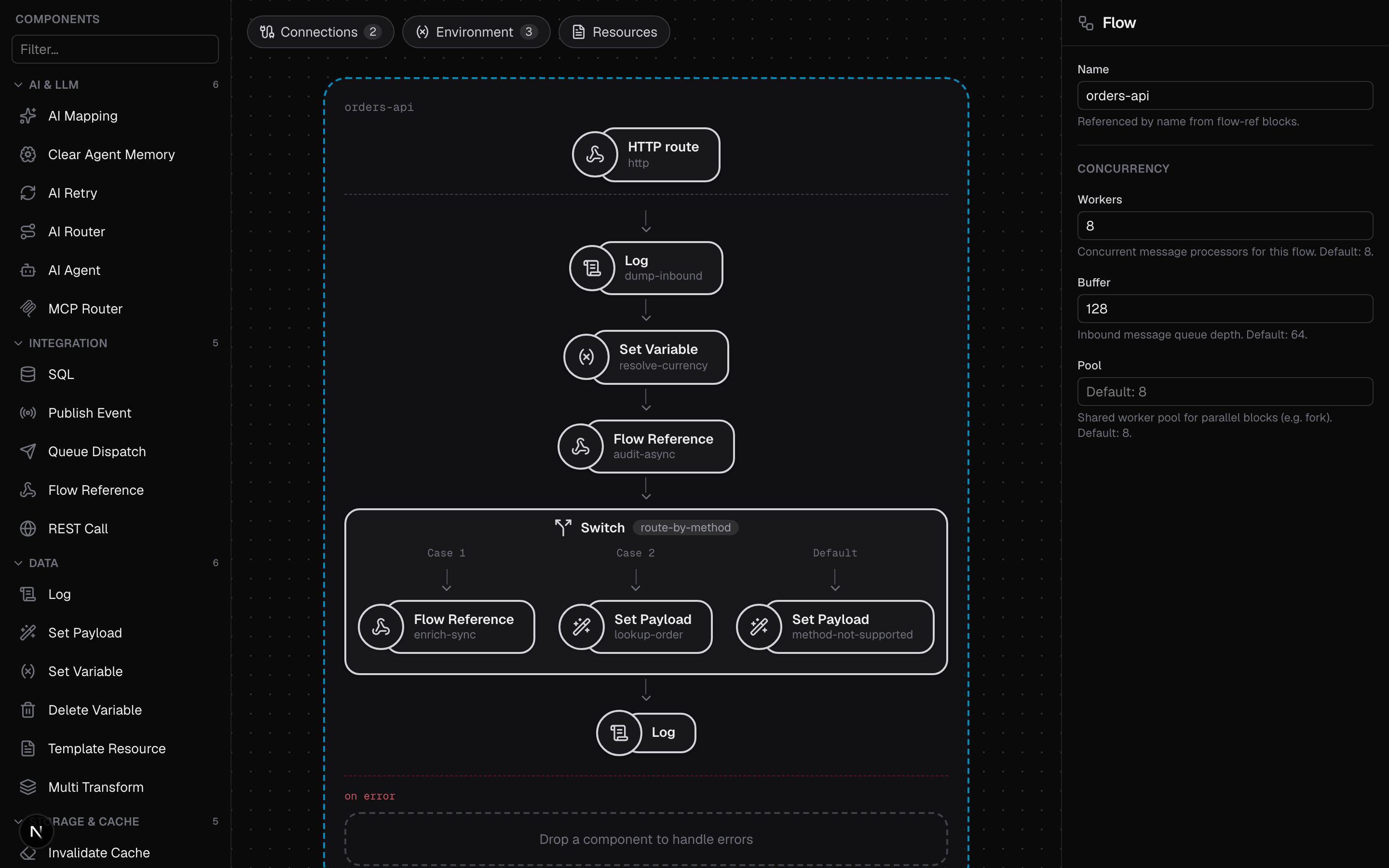
This guide builds a JSON API on the http connector: one endpoint that routes
on the HTTP method, reads path and query parameters, captures headers, and
shapes its response. It follows
samples/http-orders.yaml.
Declare the server
The http connector owns the listener; every flow that sources from it
registers a route on the same server. Variables declared under env: resolve
as OS environment, then .env file, then the default.
env:
  - name: HTTP_HOST
    default: 0.0.0.0
  - name: HTTP_PORT
    default: "8080"
  - name: HTTP_BASE_PATH
    default: /api/v1

connectors:
  - name: api
    type: http
    settings:
      host: ${HTTP_HOST}
      port: ${HTTP_PORT}        # an exact ${VAR} keeps its type -> int 8080
      basePath: ${HTTP_BASE_PATH}
      keepAlive: true
      requestTimeout: 5s        # how long a handler waits for the flow to finish
      readTimeout: 10s
      writeTimeout: 10s
      idleTimeout: 60s
Register a route
A flow with an http source becomes an endpoint. A path parameter such as
{id} becomes vars.id. Headers listed in headers: are copied into vars,
e.g. vars["X-Tenant"]. correlationIdHeader propagates a request ID through
the flow as correlationID, and maxBodyBytes caps the request body.
workers and buffer set how many messages run in parallel and how many can
queue before the source blocks.
flows:
  - name: orders-api
    workers: 8
    buffer: 128
    source:
      connector: api
      type: http
      settings:
        path: /orders/{id}            # {id} -> vars.id
        correlationIdHeader: X-Request-Id
        headers: [X-Tenant]           # captured as vars["X-Tenant"]
        timeout: 5s
        maxBodyBytes: 1048576         # 1 MiB
The URL is the base path plus the route: POST /api/v1/orders/42 triggers this
flow with vars.id == "42" and vars.method == "POST".
Read query parameters
vars.query is always a map (possibly empty); guard optional parameters with
has():
    process:
      - type: set-variable
        name: resolve-currency
        settings:
          name: currency
          value: 'has(vars.query.currency) ? vars.query.currency : "USD"'
Route on the HTTP method
The source stores the method in vars.method and a switch block routes on
it. Each case runs its own processor chain; default catches everything else.
      - type: switch
        name: route-by-method
        cases:
          - when: 'vars.method == "POST"'
            process:
              - type: flow-ref
                name: enrich-sync
                settings:
                  flow: enrich-order   # delegate to another flow, wait for its result
          - when: 'vars.method == "GET"'
            process:
              - type: set-payload
                name: lookup-order
                settings:
                  value: '{"orderId": vars.id, "currency": vars.currency, "status": "found"}'
        default:
          process:
            - type: set-payload
              name: method-not-supported
              settings:
                value: '{"error": "method " + vars.method + " not supported"}'
The POST case delegates to a second flow with flow-ref; the called flow's
result folds back into the message (see Composing Flows).
The sample's enrich-order flow builds the response from the body, the captured
header, and the correlation ID:
  - name: enrich-order
    process:
      - type: set-payload
        name: normalize-order
        settings:
          value: >
            {
              "orderId":   vars.id,
              "tenant":    vars["X-Tenant"],
              "item":      body.item,
              "amount":    body.amount,
              "currency":  vars.currency,
              "requestId": correlationID
            }
      - type: if
        name: priority-check
        condition: 'body.amount >= 1000.0'
        then:
          process:
            - type: set-variable
              settings: { name: priority, value: '"high"' }
        else:
          process:
            - type: set-variable
              settings: { name: priority, value: '"normal"' }
      - type: set-payload
        name: wrap-response
        settings:
          value: '{"order": body, "priority": vars.priority, "status": "accepted"}'
Shape the response
The body at the end of the chain is serialized as the JSON response. The status
code defaults to 200; set the httpStatus variable to override it, for example
a 405 from the default case:
            - type: set-variable
              settings: { name: httpStatus, value: "405" }
Run it
bin/octo run --config samples/http-orders.yamlCreate an order:
curl -s -X POST localhost:8080/api/v1/orders/42 \
  -H 'X-Tenant: acme' -H 'X-Request-Id: req-1' \
  -d '{"item":"widget","amount":1500}'
{
"order": {
"orderId": "42",
"tenant": "acme",
"item": "widget",
"amount": 1500,
"currency": "USD",
"requestId": "req-1"
},
"priority": "high",
"status": "accepted"
}Read one back with a query parameter:
curl -s 'localhost:8080/api/v1/orders/42?currency=EUR'{"orderId": "42", "currency": "EUR", "status": "found"}Override a declared env var at startup with
HTTP_PORT=9090 bin/octo run --config samples/http-orders.yaml, or put it in a
./.env file.
Where to go next
- Database CRUD: back these endpoints with SQL.
- Validation and Auth: reject bad input and require JWTs.
- Composing Flows: the
flow-refpattern in depth. - HTTP connector reference: every setting on the connector and source.