
Event Bus
How the orchestrator and runtimes coordinate over NATS.
One NATS broker is the platform's message backbone. Control-plane events, runtime work queues, and log shipping all share it, separated by subject namespace rather than by broker. This page maps what flows over it and how events reach the browser.
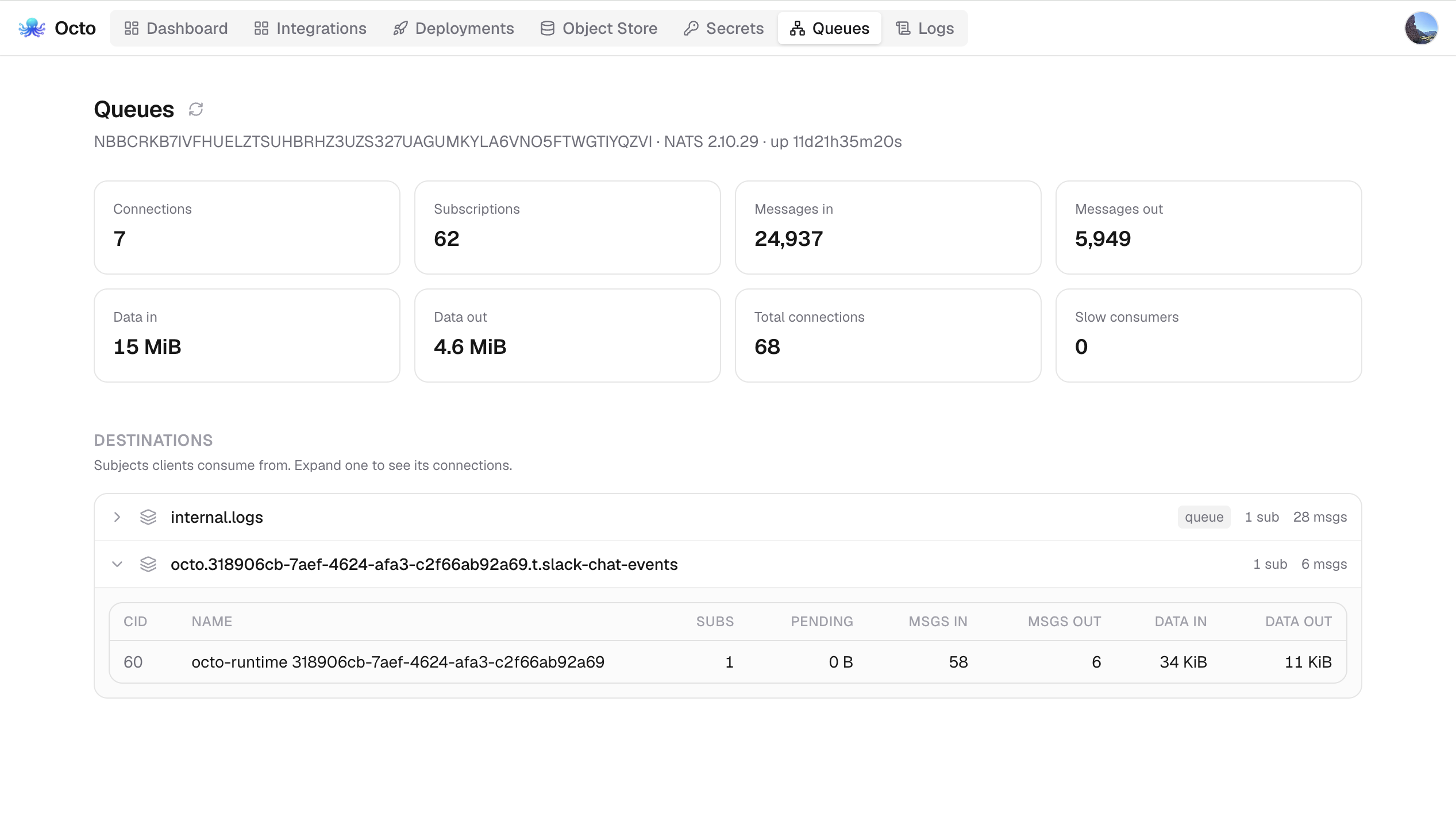
Subject map
| Subject | Publisher | Consumer | Purpose |
|---|---|---|---|
internal.deployments.{integrationId} | orchestrator | platform BFF (per-integration SSE) | Deployment status snapshots |
internal.integrations.events | platform BFF (MCP writes); deployed apps via system: | platform BFF (SSE) | Integration-write live-reload hints |
internal.logs | every runtime pod | observability service (queue group) | Structured log shipping |
internal.traces | every runtime pod with tracing on | observability service (queue group) | Trace record shipping |
octo.{deploymentId}.q.{subject} | runtime pods | runtime pods (queue group) | Flow queues: competing consumers |
octo.{deploymentId}.t.{subject} | runtime pods | runtime pods (plain subscribe) | Flow topics: broadcast fan-out |
Control-plane infrastructure lives under internal.*; runtime messaging is scoped per deployment under octo.{deploymentId}.*, so deployments sharing the broker cannot collide with each other or with the platform's own traffic.
A deployed app can publish onto an internal.* subject deliberately, by writing the subject with a system: prefix, which opts that one subject out of deployment scoping. The platform agent uses it to tell an open editor that something it just changed is worth re-reading.
internal.logs and internal.traces are not scoped per deployment: a single service consumes each as a competing consumer across every deployment, and the deployment identity travels inside each record. Scoping them would make its subscription list grow with the number of deployments.
Both subjects are consumed by the same observability service. Traces landed there because they arrive the same way and are queried the same way.
The two consumers behave differently under load. Log records are inserted one at a time by a small worker pool. Trace records are batched (one request through a ten-block flow emits a couple of dozen of them against a log line or two), and when the writer falls behind, the trace consumer sheds records rather than waiting for room, because its subscription callback shares a connection with the log consumer and blocking there would stall log shipping too. The count of what was dropped is logged.
Orchestrator events: deployment status
The orchestrator runs Kubernetes informers over the deployments and pods it manages. On every cluster change it recomputes the affected integration's full deployment list, the same JSON array the REST list endpoint returns, and publishes it to internal.deployments.{integrationId}. Publishing is fire-and-forget: a broker hiccup is logged and never blocks the write path.
The platform BFF holds a single lazily opened NATS connection. Its SSE route (GET /api/integrations/{id}/deployments/events) subscribes to the integration's subject and relays each snapshot to the browser as a Server-Sent Events frame. Because the fan-out goes through NATS rather than process memory, it works across multiple platform replicas. Snapshots carry the same wire shape as the REST response, so the browser parses a streamed frame and a polled response identically.
Integration-write events
When an MCP client creates or updates an integration, the BFF publishes an integration.updated event (the integration's id and name) so an editor with that integration open can live-reload it. With NATS configured the event goes to internal.integrations.events and reaches editors on any replica; the SSE route GET /api/integrations/events relays it. Delivery is fire-and-forget by contract: an MCP write never fails because the reload hint could not be delivered.
A deployed app can publish the same event, with a publish-event block whose subject carries the system: prefix:
- type: publish-event
  settings:
    subject: '"system:internal.integrations.events"'
    value: '{"type": "integration.updated", "id": body.id, "name": body.name}'
The payload is the message body as JSON, which is what the SSE route relays and the browser parses, so it must match one of the OctoEvent shapes. Nothing checks that: a malformed event reaches the browser and is ignored. This is the path the platform agent uses after it writes an integration on your behalf.
The in-process fallback (packages/events)
@octo/events is a small shared package: the OctoEvent types, an in-process publish/subscribe bus, an SSE Response builder, and the browser EventSource client. When NATS_URL is unset or the broker is unreachable (the standalone app, local development, a single-replica deploy without a broker), the BFF publishes on this in-process bus instead, which reaches editors connected to the same process. The subscription API the browser sees is identical either way.
Degradation without a broker
Everything on this page is optional infrastructure:
- The orchestrator's publisher is a noop when
NATS_URLis unset; writes and deploys work unchanged. - The deployments SSE route answers
503, and the browser falls back to polling the REST list. - Integration-write events fall back to the in-process bus.
- Runtime queues, topics, and log shipping do require NATS in clustered runs: the k8s services module refuses to start a pod without
NATS_URL, surfacing the misconfiguration at startup rather than on first use.
The chart deploys NATS by default (nats.enabled) as core NATS: ephemeral fan-out with no JetStream persistence. Events are live signals, not a durable event log; a subscriber that was not connected catches up from the REST API.
Relationship to runtime messaging
The runtime's queue and topic constructs (see Clustering) use the same broker through the same injected NATS_URL, but they are user-level messaging between a deployment's replicas: deployment-scoped subjects, queue groups for competing consumers, native request-reply. The internal.* subjects are platform plumbing. A flow's subjects are scoped to its deployment, and platform components never consume flow queues.
The one crossing is one-way and enforced: a flow that writes system: in front of a subject publishes onto the unscoped plane, and a flow that tries to subscribe to one is refused. Raising a platform event is the capability; reading the platform's traffic (internal.logs and internal.traces carry every deployment's records) is not.