
Resources and Secrets
Integration resources, cluster secrets, and how they reach running flows.
Two stores configure what a deployed integration runs with. Resources are env files and templates authored per integration and versioned with its tags. Cluster secrets are sensitive values stored once per cluster and bound to deployments by reference. Together with per-deployment env bindings they supply everything a definition's env declarations need.
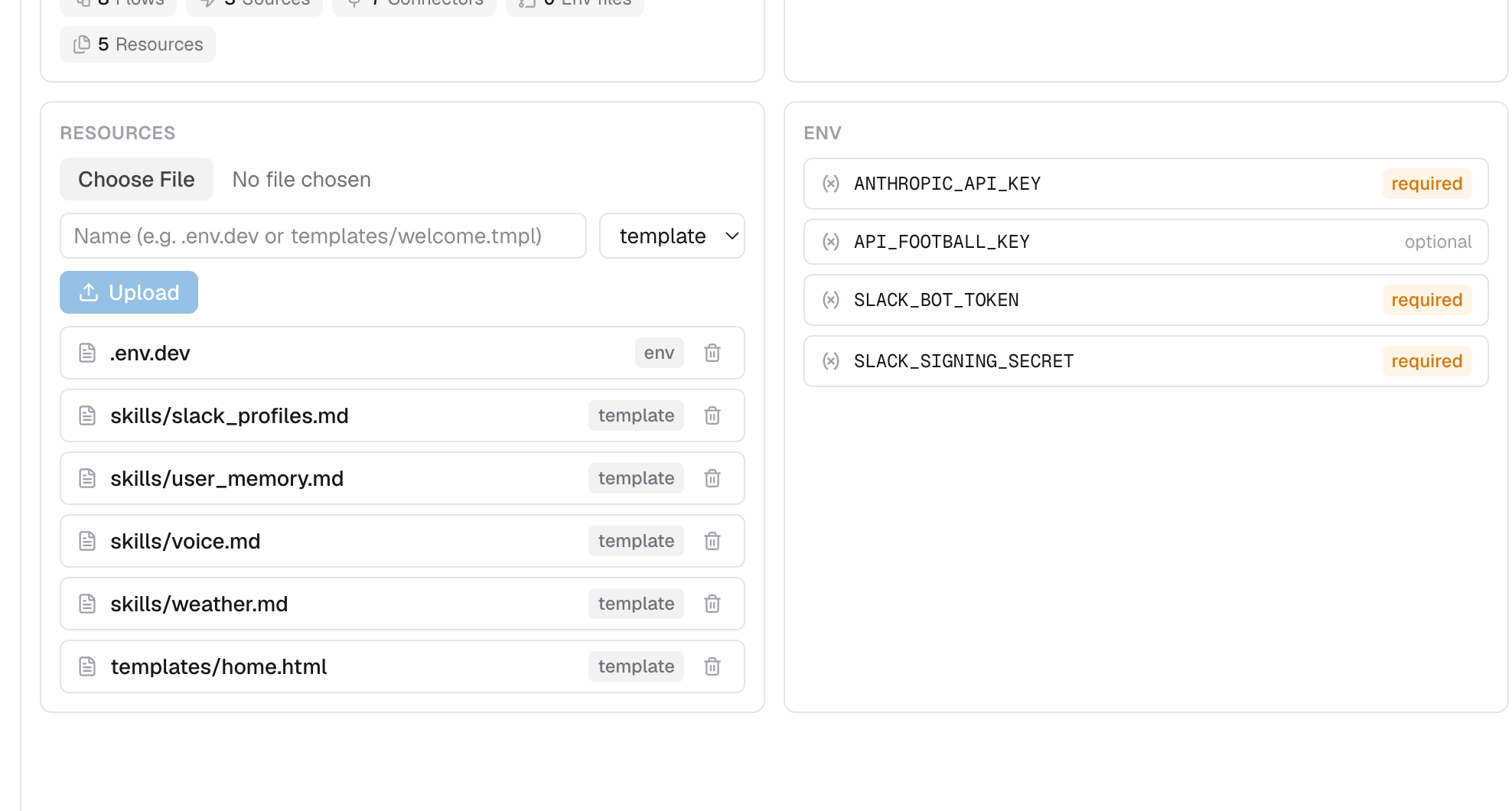
Integration resources
Resources are the platform counterpart of the files the standalone runtime reads from its config directory. Each resource belongs to one integration and has three fields.
kind is either env (a .env-convention file combined into the runtime environment) or template (a text template rendered by flows; see Resources).
name is the id the definition references. Names are path-like (they may contain /, so a resource keeps its relative path through a bundle) but must stay relative: no leading /, no .., no empty segments.
content is the raw text.
The working copy of a resource is mutable through the editor or MCP; the REST surface is POST/GET /integrations/{id}/resources and GET/PUT/DELETE /integrations/{id}/resources/{resourceId}. A name is unique per integration.
A resource shares storage with the integration's flow files, so its name may not be one that would make it a flow file — a root-level *.yaml or *.yml is config to the runtime whatever wrote it. Nest it (templates/report.yaml) or rename it. Writes record who made them, the same way an integration's do.
Each resource downloads on its own from the Resources panel, and an integration with all of its resources downloads and uploads together as a bundle.
Resources are versioned with tags
Creating a version tag freezes a copy of the integration's resources alongside its definition, in the same transaction. A deploy ships the tag's frozen resources, so later edits to the working copy don't touch running deployments.
How resources reach a running pod
A deployed pod carries its snapshot id (OCTO_SNAPSHOT_ID). At load time, the runtime's resource loader fetches each declared resource from the orchestrator's frozen-resource endpoint (GET /snapshots/{id}/resources/content). Env resources are folded into the environment; templates are served to template-resource blocks and the templateResource() function.
Cluster secrets
Cluster secrets hold sensitive values (API keys, connection strings) once per cluster. Values live only in Kubernetes, as keys of a single shared Secret (octo-secrets) in the platform namespace. The database keeps a catalog of names and timestamps only; no API ever returns a value.
Set a secret with PUT /secrets/{name} (creating or overwriting), list names with GET /secrets, and delete with DELETE /secrets/{name}. Deleting a secret that a deployment still references is refused unless forced, since it would break that workload on its next restart.
At deploy time you bind a declared env var to a secret by name. The orchestrator validates the secret exists, then injects it into the pod as a secretKeyRef env var; the deployment record stores only the secret's name, never its value. A pod referencing a since-deleted key fails to start visibly rather than running without the value.
Cluster secrets are for deploy-time configuration. Secrets that flows write at runtime (e.g. rotating tokens) go through the runtime secret store, which the platform backs with encrypted KV namespaces. See KV Store and Persistence.
How values reach flows, and precedence
A deployed runtime resolves each declared env var with the standard precedence; the platform supplies the sources:
- The container environment always wins. This is where deploy-time bindings land: literal values and secret references both become container env vars, alongside the orchestrator-managed
HTTP_PORT/HTTP_HOST. - Env resources next: the tag's frozen
.envfiles, loaded by the runtime in declared order. - The declared
defaultin the definition itself, last.
Three consequences are worth knowing. A binding left empty in the deploy dialog injects nothing, so an env-resource value (or a default) still applies instead of being clobbered by a blank. A required variable must be provided by a binding or a frozen env resource, because a default does not satisfy it, and the deploy (or rollout) is rejected up front when one is missing. HTTP_PORT and HTTP_HOST are orchestrator-managed and cannot be bound.
The deploy dialog reflects all of this: it lists the tag's declared variables, marks the ones its frozen .env resources already satisfy, and prompts for the rest.