Platform Overview
What the multi-user platform adds: deployments, secrets, and orchestration.
The Octo platform is the cloud-native, multi-user counterpart to the standalone editor: the same visual editor, backed by a control plane that stores integrations in Postgres and deploys each one as its own Kubernetes workload. The standalone editor reads flow files from a local directory; the platform gives a team shared storage, versioning, one-click deployments, and central operations.
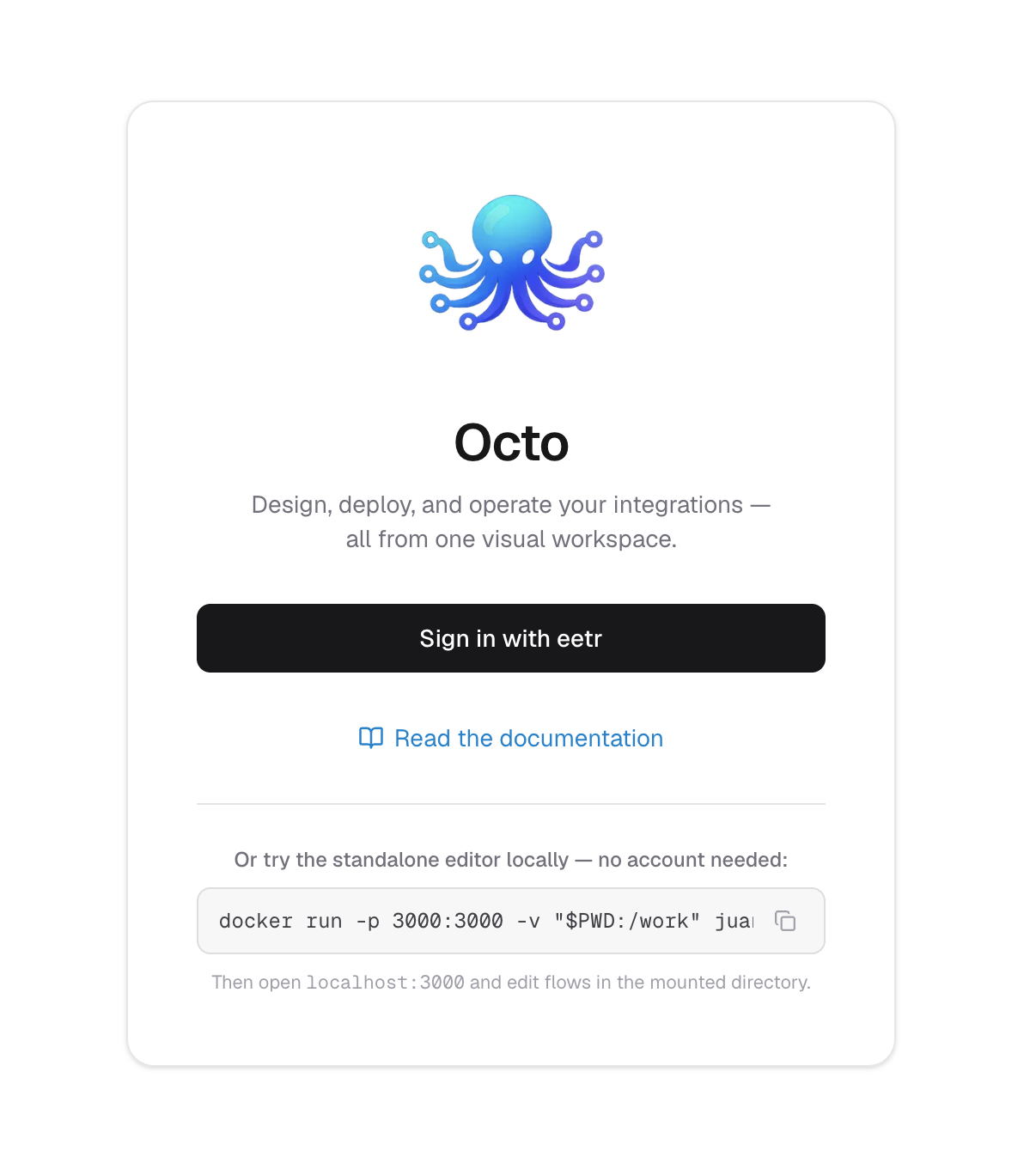
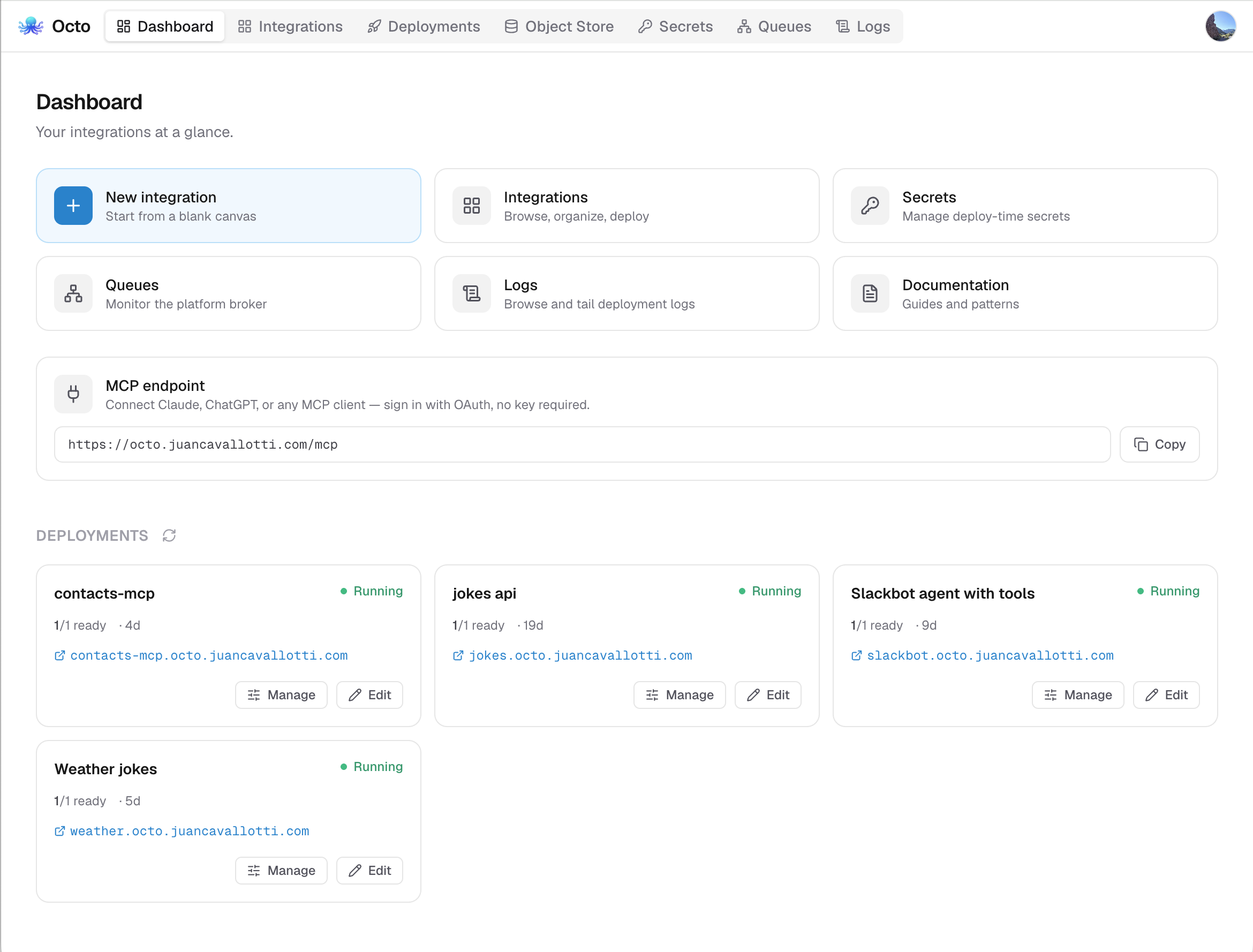
Signing in lands you on the dashboard, an overview of your integrations and their live deployments:
What the platform adds
- OIDC single sign-on (Auth.js) gates the whole app. Each teammate gets a durable user identity, integration edits are attributed to the user who made them, and write operations can be restricted to specific roles.
- Integrations live in Postgres, uniquely named and organized into folders, instead of files on one person's disk.
- Tagging an integration freezes its definition and a copy of its resources under an immutable name. Deployments always ship a tag, never the live working copy.
- The orchestrator turns a tag into a Kubernetes Deployment of the generic
octo-runtimeimage, with a stable internal URL per deployment and an optional public HTTPS endpoint on its own subdomain. - Env files and templates are authored per integration and frozen with each tag. Sensitive values live in a cluster-wide secret store and are bound to deployments by reference, never stored in the database.
- A deployment's replicas share a versioned, deployment-scoped key/value store in two durability tiers: Postgres for what must survive a restart, with encrypted-at-rest secret namespaces, and Redis for what need not. An object browser inspects and edits stored values and reports how full each store is.
- Every runtime pod ships structured logs over NATS to the observability service, which persists them to Postgres, queryable across all deployments.
- Per-user bearer keys (and OAuth access tokens) authenticate programmatic clients, including the platform's MCP endpoint for AI-assisted authoring.
- Deployment status streams from Kubernetes informers through NATS to the browser as Server-Sent Events, so you watch pods come up in real time.
The pieces
Two services make up the control plane. The platform app (apps/platform) is a Next.js app that serves the editor and fronts everything as a backend-for-frontend. The orchestrator (orchestrator/) is a Go HTTP API that owns the database and is the only component that talks to the Kubernetes API. Architecture walks through how they fit together.
Architecture
The platform app, orchestrator API, NATS, Postgres, and runtime workloads.
Integrations
Authoring, organizing, and managing integrations on the platform.
Deployments
Deploying integrations as Kubernetes workloads: rollouts and rollbacks.
Snapshots
Version tags: freezing definitions and resources for deployment.
Resources and Secrets
Integration resources, cluster secrets, and how values reach running flows.
KV Store and Persistence
The deployment-scoped key/value store and the platform database.
Users and API Keys
Authentication, user management, and API tokens.
Event Bus
How the orchestrator and runtimes coordinate over NATS.
The Self-Healing Loop
How a signal a pod emits becomes an alert an agent triages, reports on, and can act on.
Running the platform
The platform ships as a Helm chart with images for every component. See Deploying with Helm for the chart, GCP with Terraform for a complete single-VM reference deployment, and Local k3d for a development cluster.